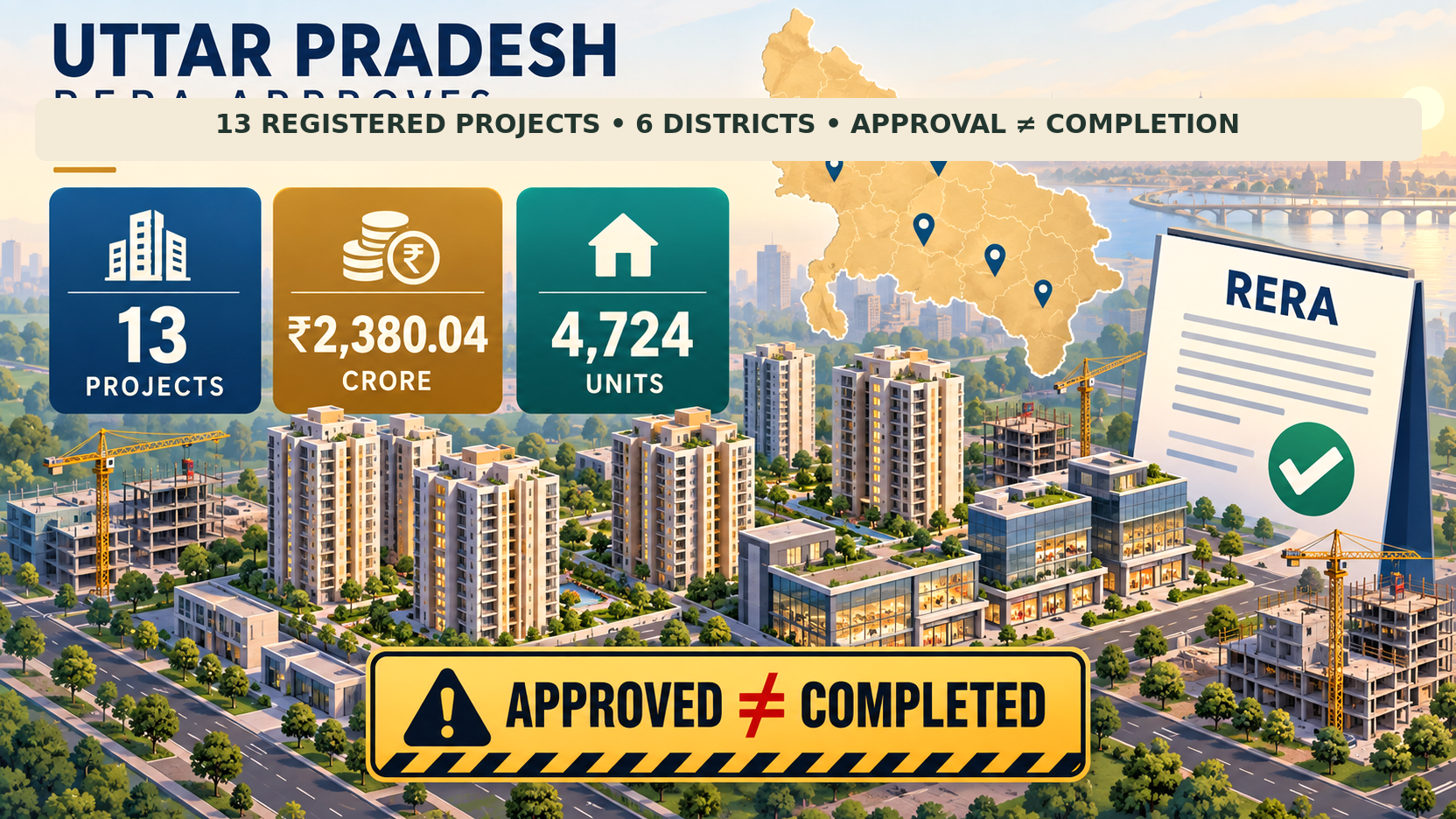
UP RERA has approved 13 real-estate projects across six Uttar Pradesh districts, with estimated investment of ₹2,380.04 crore and 4,724 proposed residential and commercial units. The scale is meaningful, especially because Barabanki leads the investment tally while Lucknow leads the unit tally. But a UP RERA project approval is a regulatory registration step: it is not a certificate that construction is finished, possession is certain, or every advertised unit is ready to buy.
Barabanki leads investment; Lucknow leads units
The projects span Barabanki, Lucknow, Varanasi, Ghaziabad, Gautam Buddh Nagar and Agra. According to the UP RERA statement reported by PTI, Barabanki has two residential projects with ₹751.42 crore of proposed investment and 591 units. Lucknow has one residential project with ₹385.76 crore of proposed investment and 1,392 units. So the district with the most money in the announcement is not the district with the most proposed homes.
Varanasi accounts for ₹750.24 crore and 1,189 units, while Ghaziabad has three projects—two commercial and one residential—with ₹286.27 crore and 864 units. Gautam Buddh Nagar has one residential and one commercial project worth about ₹186 crore with 564 units, and Agra has ₹20.35 crore with 124 units. These are proposed project totals, not a list of sale prices, launch dates or completed inventory.
₹2,380.04 crore is an investment estimate, not a price tag
One crore rupees equals 10 million rupees, so ₹2,380.04 crore is ₹23.8004 billion. Dividing that estimate by 4,724 proposed units gives roughly ₹50.38 lakh per unit. That arithmetic may look like an average home price, but it is not: the numerator is estimated project investment, and the denominator mixes residential and commercial units across six districts.
The distortion becomes obvious when districts are compared. Barabanki's ₹751.42 crore divided by 591 units is about ₹1.27 crore per proposed unit, while Lucknow's ₹385.76 crore divided by 1,392 units is about ₹27.71 lakh. The gap can reflect land, commercial space, project design, infrastructure, unit size and accounting scope; it does not prove that a Barabanki flat costs 4.6 times a Lucknow flat.
Registration improves disclosure, but construction risk remains
RERA registration gives buyers a formal project record and brings the promoter under disclosure and compliance duties. That is valuable because it creates a place to check the registration number, promoter, declared schedule and project status. Still, registration does not remove execution risk, and the newly approved count should not be read as 4,724 homes that can be occupied now.
If I were preparing to book a home, the large investment headline would feel encouraging because it signals a broader pipeline. The same headline would also make me slow down: a pipeline is not a handover. The useful question is not only whether the project appears in this announcement, but what the official project page says about its sanctioned plan, declared completion date, quarterly progress and any later status change.
Verify the project record before sending money
Start with the promoter's exact UP RERA registration number and match the project name, district and phase on the regulator's registered-project search. Then read the declared completion date, approvals, quarterly progress reports and uploaded documents; compare them with the brochure and draft agreement. A similarly named project or another phase is not a safe substitute for the record tied to the unit you are considering.
UP RERA advises allottees to pay the promoter only through the project's designated Collection Account and to report payments collected through another account. Before any transfer, match the account shown by the regulator with the account in the demand letter, and retain the receipt and bank trail. This check does not replace an independent title review, loan sanction or legal advice, but it can catch a basic mismatch before money leaves your account.
Treat the approval as a starting document, not a finish line
The 13 approvals expand Uttar Pradesh's registered development pipeline and show that growth is spreading beyond one city. For a buyer, however, the headline total answers only how much investment and how many units are proposed. It does not answer the price of a specific home, the strength of the promoter, the status of construction or the date of possession. The most useful response is therefore simple: use the approval to find the exact official record, then make the payment decision from the project's current documents and your own affordability—not from ₹2,380.04 crore alone.
Sources and dates
- UP RERA: official portal, project search and Collection Account guidance
- UP RERA: official registration verification service
- PTI: UP RERA statement on 13 projects across six districts
- Hindustan Times: PTI report with district investment and unit breakdown
- The Statesman: separate local report on the same approval announcement