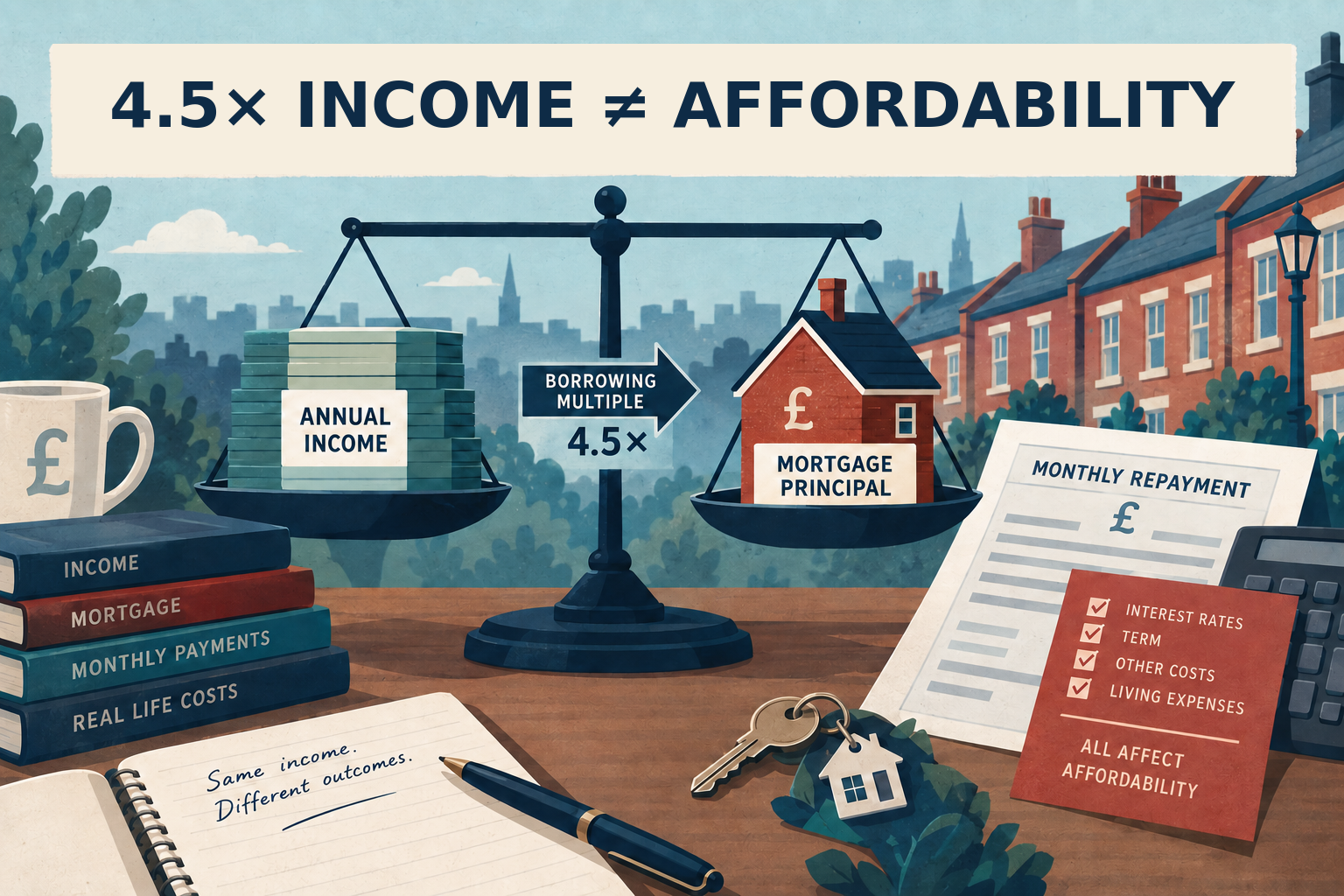
The number of UK first-time buyers taking mortgages above 4.5 times their income rose by 66% to 45,800 in 2025, according to figures reported by the Financial Times on 11 September. That is a striking rise, but the count is not 45,800 defaults and it does not mean every first-time buyer borrowed at that level. It records completed lending above a particular loan-to-income threshold, not whether each household's monthly budget felt comfortable.
The 4.5× number is a multiple, not a mortgage rate
Loan-to-income, shortened to LTI, divides the mortgage principal by the borrower's annual gross income. A £202,500 loan on £45,000 of income equals 4.5× because £202,500 ÷ £45,000 = 4.5. The calculation does not include the interest rate, term, council tax, service charges, childcare or other debts.
That omission is why a larger approved loan can feel exciting and unsettling at the same time. The multiple shows how large the principal is relative to income, while affordability checks ask whether repayments still fit after regular spending and possible financial stress. Passing one lender's assessment is not a promise that the same payment will remain easy for the household.
Lender flexibility did not remove the market-wide guardrail
The Bank of England's Prudential Regulation Authority said in July 2025 that the existing rule limited mortgages at or above 4.5× income to no more than 15% of a lender's new residential mortgages each year. Its interim change allowed participating lenders to exceed that firm-level share while policymakers aimed to keep aggregate high-LTI lending consistent with the 15% market limit. That is flexibility in where the loans are made, not permission for unlimited high-multiple lending.
The same statement said the temporary modification would end by 30 June 2026 at the latest or earlier if the rule changed. It therefore explains the route into the 2025 increase, but it should not be used alone to claim that a particular September 2026 mortgage product is available. Buyers still need the current lender criteria, a personalised illustration and the applicable regulator information.
Two official-looking high-LTI percentages may use different cut-offs
The FCA's mortgage statistics said 46.5% of gross advances in the fourth quarter of 2025 went to borrowers it classed as high LTI. However, that series defines high LTI as at least 4× income for a single-income borrower or at least 3× for joint-income borrowers. It is not the same denominator or threshold as the 45,800 first-time-buyer loans above 4.5×, so the two figures should not be placed side by side as if they measured the same group.
This distinction matters because a percentage can look much larger simply because its boundary is lower and its population is broader. When comparing mortgage statistics, check three labels before drawing a conclusion: whether the unit is loans or pounds, whether the borrowers are first-time buyers or all borrowers, and exactly where the income multiple begins. A missing label can change the story more than a decimal point does.
An extra turn of the multiple becomes a real monthly bill
Consider a clearly hypothetical borrower earning £45,000. At 4.5× income the principal is £202,500; at 5.5× it is £247,500, a £45,000 difference. On a 30-year repayment mortgage at a constant 5% rate, the illustrative monthly payments are about £1,087 and £1,329 respectively, before fees and insurance—a difference of roughly £242 each month.
That example is not a quote and it assumes the rate never changes for the full 30 years, which a real product may not do. Recalculate with the product's initial rate, follow-on rate, term and fees, then test a rate two percentage points higher and a period of reduced income. If the budget only works at the introductory payment, the extra borrowing capacity may be solving the deposit gap by creating a cash-flow problem.
Treat the multiple as a ceiling to test, not a target to reach
The 45,800 figure shows that high-LTI borrowing became more common among first-time buyers in 2025; it does not tell us that those loans were unsuitable or safe for every borrower. A useful decision starts with the exact principal and monthly payment, then adds housing charges, other debts and a realistic stress case. Borrowing less than the maximum can be a deliberate choice, because the lender's ceiling and the household's comfortable limit answer different questions.